
What Is Save Soil? A Yoga Teacher's Take on Conscious Planet
People are sometimes surprised when a yoga teacher starts talking about dirt. Yoga is supposed to be about the inner world — breath, stillness, energy. What does the ground under a farmer's feet have to do with any of that?
Everything, as it turns out. And a few years ago a movement called Save Soil made that connection impossible for me to ignore.
What Save Soil actually is
Save Soil is a global movement launched in 2022 under the banner of Conscious Planet, started by Sadhguru. Its aim is unusually specific for something so large. It isn't a vague call to "care about the environment." It's a single, measurable policy ask: that governments act to keep a minimum of 3–6% organic content in agricultural soil.
That number matters because soil is quietly dying. Strip the organic matter and the microbial life out of soil and you don't get poor farmland — you get sand. The United Nations has warned that soil degradation and desertification could cost the world as much as $23 trillion by 2050 in lost food, water and income. Scientists have a blunt word for what happens when soil loses its living content: soil extinction.
To put this in front of world leaders, Sadhguru — then 64 — rode a motorcycle 30,000 kilometres across 27 countries in 100 days, from London to the south of India. Along the way the movement reached billions of people, gathered support from more than 70 nations, and produced 193 individual soil-policy handbooks, one tailored to each country. He carried the message all the way to the UN's COP15 desertification conference and spoke before delegates from 193 nations.
You can read the movement's own account of all this at consciousplanet.org
Why this lands for me as a hatha yoga teacher
Here's the part I actually want to say.
In classical hatha yoga, we don't treat the human being as separate from the planet. The body is understood as being made of the same five elements — earth, water, fire, air and space — as everything around it. One of the practices I teach, Bhuta Shuddhi, is entirely about cleansing and harmonising these five elements within you. The very first of them, prithvi, is earth.
So when I sit with the idea of soil dying, it doesn't feel like an "environmental issue" filed away somewhere outside my practice. It's the same conversation. The earth element in my body and the soil in the ground are not two different things wearing different names — they're one continuous substance. What I eat was soil a season ago. What I am will be soil again. A yoga that claims to be about union while ignoring the ground it stands on isn't really union at all.
It hit me hard when it landed. All life depends on the soil being healthy — every meal, every forest, every future generation rests on those few inches of living earth. If we don't act, the legacy we leave will be catastrophic for life on this planet. And I don't want to be a being that only takes and never gives back. That, more than any statistic, is what pulled me in.
Inner ecology and outer ecology
Sadhguru often frames it this way: unless human beings become conscious of the life around them, they will keep consuming the planet without noticing. Yoga, at its root, is a technology for exactly that kind of consciousness — it widens your sense of what "you" includes until the boundary between you and the world gets thin.
That's not a metaphor I reach for to sound poetic. It's a practical observation. People who practise sincerely tend to become gentler with everything — their bodies, their food, their surroundings. Care for the outer world isn't a rule you bolt on afterwards; it tends to arrive on its own once the inner work is underway. Save Soil simply gives that care something concrete to do.
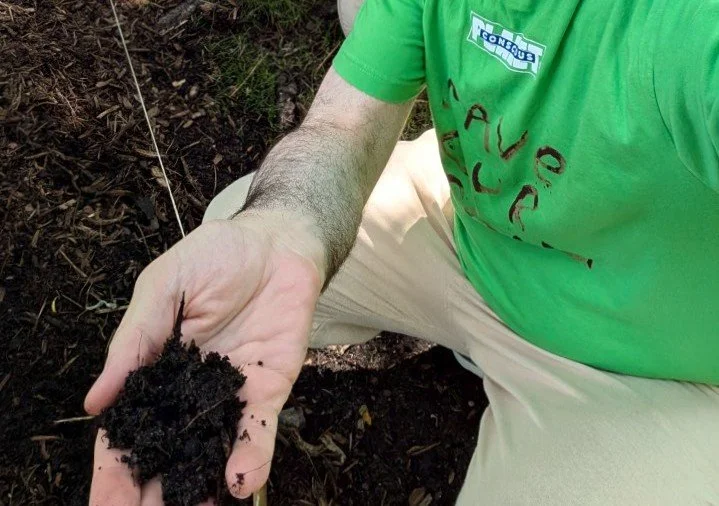
In my own small way, I keep it visible. I wear the Save Soil shirt, and the sticker is on display at the studio. Whenever the moment allows, I tell people what's at stake — that this needs awareness, that it needs governments to act, and that it needs to happen now, not later. A studio is a good place to start a conversation, and I use it.
What you can do
If any of this stayed with you, you don't need to ride a motorcycle across the world. You can:
- Learn what's actually happening to soil — start at the movement's own site, Conscious Planet
- Take the Save Soil pledge, a two-minute act of support that adds your voice to the policy ask.
- Bring the same attention inward. If the idea that you and the earth are made of the same elements interests you, the Bhuta Shuddhi practice works with exactly that — or have a look at all upcoming programs and I'll help you find a place to begin.
The planet doesn't need a few people practising yoga perfectly. It needs a great many people becoming a little more conscious of the ground they stand on. That's work we can all start today — on the mat and off it.
— Dan
What is the Save Soil movement?
Save Soil is a global movement launched in 2022 under Sadhguru's Conscious Planet initiative. It calls on governments to keep a minimum of 3–6% organic content in agricultural soil, to prevent soil degradation and "soil extinction."
Who started Conscious Planet and Save Soil?
Sadhguru, founder of the Isha Foundation. In 2022 he rode a motorcycle 30,000 km across 27 countries in 100 days to raise awareness and meet world leaders, carrying the message as far as the UN's COP15 desertification conference.
What does saving soil have to do with yoga?
In classical hatha yoga the body is understood as made of the same five elements as the earth — earth, water, fire, air and space. The practice of Bhuta Shuddhi works directly with these elements. Caring for the soil of the planet and the earth element within us is the same concern.
How can I support Save Soil?
You can learn about it and take the Save Soil pledge at consciousplanet.org. Beyond that, becoming more conscious of your own relationship with the natural world — much of what yoga cultivates — is itself part of the movement's aim.
